Human Design Profile
Profile 1/3 · The Investigator · Martyr
You need a solid foundation first: research it, then learn the rest by bumping into what doesn’t work. Your “failures” are data; nobody finds the dead ends faster.

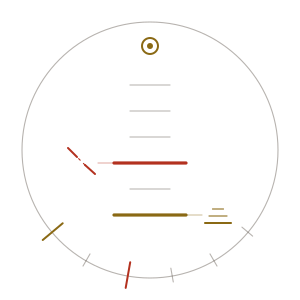
A profile is two lines. The first comes from your personality Sun: the part of the costume you recognize as yourself. The second comes from your design Sun, fixed 88° before birth: the body’s style, running whether you notice it or not.
Line 1, conscious · the Investigator
The side of you that you identify with is line 1, the line of foundation. It needs to know: study it, source it, understand it from the ground up. Security comes from depth, and once the homework is real, this authority is hard to shake.
Line 3, unconscious · the Martyr
Underneath, the body runs line 3, the line of trial and error. It learns by collision: try it, watch it break, know forever what doesn’t work. None of that is failure; it’s the most practical wisdom in the system. Because this side is unconscious, other people often see it more clearly than you do.
What is a Right Angle cross?
Profiles with a Right Angle incarnation cross carry a personal destiny: the life theme unfolds through your own process, and other people are context, not cause. There is nothing selfish in that; it’s simply how this geometry completes itself.
What is it like to live the 1/3 profile?
Your profile pairs the Investigator with the Martyr: a conscious first line that needs solid ground, and an unconscious third line that finds it by falling through the floors that aren’t. The first line in you is the part you recognize: the need to research before you commit, to read the reviews, to understand the foundation of a thing before you will stand on it. Depth is not a hobby for you; it is safety. When you know a subject to the bottom, you are calm, generous and unshakeable. When you are forced to act on thin knowledge, something in you braces.
The third line works underneath, and you mostly see it in the rearview mirror: a life that learns by collision. Plans meet reality and bend; the job, the method, the relationship that was supposed to work a certain way turns out to work a different way, or not at all, and you walk away knowing something no one could have told you. The culture calls that failure. Your design calls it research by other means. Nobody on earth finds the dead ends faster than a third line, and every dead end you have personally confirmed becomes a place you can steer others past.
The two lines also shape how you bond. Third-line relationships learn by contact too: early bonds that made and broke were not evidence that you are bad at love; they were the research phase of a design that must discover what does not hold in order to recognize what does. By the time a 1/3 commits from a studied foundation and a tested history, the commitment has bedrock under it. In work, the same pairing makes you the natural auditor of the real: the one who reads the manual and then pressure-tests the machine, who can say not only what should work but what actually does. Fields that reward verified depth, craft, science, diagnostics, restoration, tend to feel like home.
Together the two lines make one of the sturdiest profiles in the system: study it, then stress-test it. Your authority decides what is worth the study and the bumping; your profile describes how the learning happens once you are in. Be gentle with your own history here. The catalog of things that didn’t work is not a record of inadequacy; it is your credential. People trust a 1/3 who says “this holds, I’ve checked” precisely because they can tell you have also found, personally, everything that doesn’t.
This profile keeps well with a little tending. First, claim the study time without apology: you are not slow to commit, you are building the floor you will stand on, and everyone benefits from the floor. Second, keep your findings where you can see them: a private ledger of what you have personally confirmed, holds and doesn’t-hold alike. On the days the old shame about the broken experiments comes calling, read the ledger. It is not a list of failures. It is the bibliography of your authority.
How common is the 1/3 profile?
We measured this ourselves rather than repeat the numbers every site copies from every other site: of 100,000 charts computed for random birth moments spread across a century, about 14% carried the 1/3 profile. Whatever the share, the count is company, not a ranking. The full tables and the method live in How common is your design?
Which well-known people had the 1/3 profile?
Carrying the 1/3: Vincent van Gogh, Pablo Picasso, Agatha Christie, Amelia Earhart, Lucille Ball, Betty White and Grace Kelly. Their birth records are public and reliability-rated (Astro-Databank via Astrotheme), and every chart was computed by our own engine from each recorded birth moment; we never copy type claims from circulating lists.
The other profiles
Your profile is read straight from the Sun lines of your chart.
Get your free chart