Human Design Profile
Profile 6/3 · The Role Model · Martyr
The role model who never stops experimenting: optimism on the roof, bruises on the ground. Your credibility is that you’ve genuinely lived it.
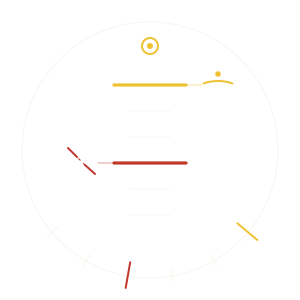
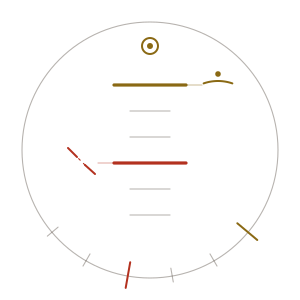
A profile is two lines. The first comes from your personality Sun: the part of the costume you recognize as yourself. The second comes from your design Sun, fixed 88° before birth: the body’s style, running whether you notice it or not.
Line 6, conscious · the Role Model
The side of you that you identify with is line 6, the line of the role model. It lives in three acts: hands-on experiment until about thirty, a long view from the roof until about fifty, then living as the example. Wisdom is the third act.
Line 3, unconscious · the Martyr
Underneath, the body runs line 3, the line of trial and error. It learns by collision: try it, watch it break, know forever what doesn’t work. None of that is failure; it’s the most practical wisdom in the system. Because this side is unconscious, other people often see it more clearly than you do.
What is a Left Angle cross?
Profiles with a Left Angle incarnation cross are transpersonal: the life theme completes itself through encounters with others. The people who cross your path are the point, not an interruption.
What is it like to live the 6/3 profile?
Your profile pairs the Role Model with the Martyr: a conscious sixth line living the long climb toward wisdom, and an unconscious third line that never stops field-testing reality. The sixth line gives your life the famous three acts: a headlong first act until about thirty, a long consolidating second act on the roof, and a third act as the lived example. But your third line underneath never signed the ceasefire: even in the watching years, even in the example years, life keeps handing you collisions, discoveries, revisions. A 6/3 does not retire from experience. The roof, for you, has a ladder, and you are up and down it your whole life.
This can feel like a design flaw: aren’t I supposed to be past this by now? You are not, and that is the gift. The pure sixth line risks becoming an observer, wise but remote; your third line keeps dragging the wisdom back down to the workbench to be tested against what actually happens. The result, over time, is a rare kind of authority: the optimism of the long view, held by someone with current calluses. When you say “life can be better than this,” people believe you, because they can see you are still in the arena finding out.
In love, this profile asks for and offers a particular honesty. The third line’s trial-and-error does not exempt relationships, and a 6/3’s history usually includes real making and breaking, sometimes late in life, when the culture insists everything should be settled. The partners who work are the ones who can live with a person still in revision: who hear “I was wrong about that, here’s what I’ve learned” as intimacy rather than instability, because in this design it is intimacy. What you offer in exchange is a rare companion: someone whose long view keeps the relationship pointed somewhere, and whose workbench honesty means the pointing gets corrected with real data, not stubbornness.
The tending this profile needs is mostly kindness toward its own rhythm. The bumps do not stop, so the aim is not a bump-free life but a resilient one: let your authority choose the experiments, let the discoveries revise the philosophy, and let neither the idealist nor the realist in you fully win. When the sixth line despairs of the mess, hand it the third line’s data: look how much we learned. When the third line wearies of breaking things, hand it the sixth line’s horizon: look where this is going. You were built as a conversation between the roof and the road, and your credibility, the deepest of any profile’s, is that you have genuinely, repeatedly, lived it.
Give yourself, finally, the structural kindnesses this rhythm needs: real recovery after the collisions, since a lifelong experimenter needs a lifelong repair shop; people who do not panic when your life revises itself at forty-five or sixty; and a flat refusal of the culture’s schedule for when a person should be finished. You were never going to be finished; you were going to be current, which is better. The 6/3 gift to everyone watching is exactly that: proof that the long view and the fresh start can share one life, and that wisdom stays trustworthy longest in the hands of someone still willing to be surprised.
How common is the 6/3 profile?
We measured this ourselves rather than repeat the numbers every site copies from every other site: of 100,000 charts computed for random birth moments spread across a century, about one in 45 carried the 6/3 profile. Whatever the share, the count is company, not a ranking. The full tables and the method live in How common is your design?
The other profiles
Your profile is read straight from the Sun lines of your chart.
Get your free chart