Human Design Center · 8 gates
The G Center
The G is the center of identity, love and direction. In the charts we measured, about 56% of people had it defined (consistent, reliable, yours) and the rest had it open (receptive, amplifying, wise about others). Neither is better, but they live very differently.

What does a defined G center mean?
Defined G: a fixed sense of identity, love and direction. You know who you are, wherever you are.
Living with a defined G
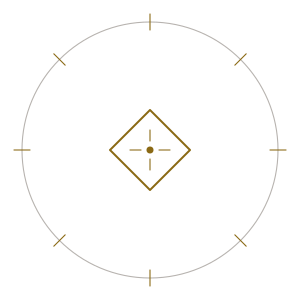
The G center, the diamond at the middle of the chart, is the seat of identity, love and direction: the magnetic core that orients a life. Yours is defined, which means who you are does not depend on where you are. You carry a fixed sense of self, a reliable inner heading, a way of loving that is recognizably yours across every context. Rooms change, jobs change, companies change; the compass needle in you points the way it points.
This is an enormous quiet privilege, and like most privileges it is easiest to see from outside. The people around you with open G centers are busy becoming whoever the room invites them to be, tasting identity through place and company; they often navigate by you without either of you noticing. A defined G is a landmark: others use you to locate themselves, calibrate their direction against your steadiness, feel “more themselves” in your presence. You do not have to do anything to provide this. You have to be, which you were going to do anyway.
In the rooms of your life this steadiness has probably been load-bearing for years: you are the one people locate against, the friend whose take on “who am I, really?” conversations carries strange weight, the presence that makes a chaotic season feel navigable. Your way of loving is consistent too: people learn what your love looks like and find it there tomorrow, which is a quiet spine for any family or partnership. The only friction the definition produces is with people mid-search: your fixedness can read to them as luck or judgment, and their shapeshifting can read to you as evasion. Neither reading is true. They are tasting; you are tuned.
Trust is what keeps this gift honest, and its edge is patience. Your sense of direction is genuinely reliable, but it reports a heading, not an itinerary: the G knows where it is pointed long before the path is visible, and it does not answer to deadlines. When you feel lost, the instrument has not broken; you are usually just between landmarks the compass already sees past. Keep loving what you love, keep facing the way you face. In this design, direction is something you simply have, and life arranges itself around people who stop arguing with theirs.
What remains is a generosity in each direction. Toward yourself: in the seasons that feel directionless, refuse the panic; a compass between landmarks is not broken, and your heading has a habit of proving itself in hindsight. Keep walking the way you face. Toward others: hold your steadiness out as shelter, not as standard. The open-G people who navigate by you do not need to be told to settle down and pick a direction; they need exactly what you already provide by existing: a fixed point, warm and unbothered, against which their beautiful, moving lives can take their bearings.
What does an open G center mean?
Open G: identity and direction are fluid; place and people shape who you are. Wisdom is choosing the right rooms.
Living with an open G
The G center is the seat of identity, love and direction: the inner compass. Yours is open, and this openness frightens people who read charts badly, so let it be said clearly: an open G is an unfixed self, not a missing one, and unfixed means free. You taste identity rather than being pinned to one: in one company you discover one version of yourself, in another place a different one, and across a lifetime you come to know the human experience of self and direction more widely than any fixed compass ever could.
The biography of an open G tends to read like several well-lived lives in sequence: chapters with different circles, different styles, sometimes different names for what you do, each one authentically yours while it lasted. The recurring ache is usually the question other people kept asking: what do you want to be? where are you headed? as if the absence of one lifelong answer were a failure of nerve. Look instead at what actually happened: you have been more selves than most people get to try, loved in more registers, seen the world from more angles of identity. That is not a broken compass’s record. It is a passport, thoroughly stamped.
The mechanics that matter most for this openness are about place and people, because they are literally where your sense of self comes from. The open G takes on the identity-weather of its environment: in the right room you feel purposeful, loved, yourself; in the wrong one you feel lost, unlovable, directionless, and neither feeling originated in you. This gives you a compass after all, just an outside-in one: how you feel about who you are is a live reading of where you are. The wisdom tradition of this center is one instruction deep: if the place feels wrong, it is wrong. Choose your rooms, and much of “finding yourself” takes care of itself.
And release, gently, the great modern demand that you settle on one fixed answer to “who am I and where am I going?” You are the one the question stays open for, and open is how you love: an open G falls in love with people, places and paths by becoming them for a while, which makes your love unusually empathic and your direction unusually adaptive. The fixed-compass people around you will supply headings all your life; enjoy them, borrow what serves, and remember that for you, direction was never supposed to be a possession. It is a dance with where you are, and you dance it beautifully when the floor is worth dancing on.
The practices are placement arts. Choose rooms, cities, and tables deliberately, and when a place feels wrong, believe it early; you are reading real information the fixed-G people around you literally cannot feel. Let the people you love know that your shape-shifting is participation, not deception: with them you become something specific and true. And when the direction question comes, from the world or from the mirror at 2 a.m., answer it the way your design actually works: not “here is my fixed destination” but “here is who and where I am becoming lately, and I chose the where on purpose.” A well-placed open G is among the most alive presences in the system. The whole art is the placing.
The gates of the G
Its channels
- Channel of Inspiration (1-8)
- Channel of The Beat (2-14)
- Channel of Rhythm (5-15)
- Channel of The Alpha (7-31)
- Channel of Awakening (10-20)
- Channel of Exploration (10-34)
- Channel of Perfected Form (10-57)
- Channel of The Prodigal (13-33)
- Channel of Initiation (25-51)
- Channel of Discovery (29-46)
Is your G defined or open? Your chart knows.
Get your free chart