Human Design Center · 9 gates
The Root Center
The Root is the pressure center of adrenaline and drive. In the charts we measured, about 61% of people had it defined (consistent, reliable, yours) and the rest had it open (receptive, amplifying, wise about others). Neither is better, but they live very differently.

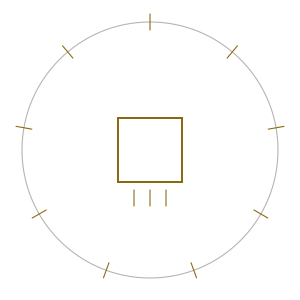
What does a defined Root center mean?
Defined Root: consistent pressure-handling. You set your own pace under stress; others borrow it from you.
Living with a defined Root
The Root, the square at the base of the chart, is a pressure center and a motor at once: the source of stress, drive, adrenaline, the fuel that gets things started and gotten through. Yours is defined, which means the pressure is your own, arriving in your own consistent pattern, on your own clock. Stress, for you, is not an ambush from outside; it is an internal tide you have lived with so long you may never have noticed its rhythm. There is a pace at which you handle load, and it is yours, reliable, and non-negotiable.
This makes you one of the world’s shock absorbers. Deadlines, crises, the general roar of existence: a defined Root processes pressure without being flooded by it, and everyone near you can feel that. Open-Root people, who receive the world’s pressure amplified and always feel behind, borrow your calm the way cold hands borrow a fire; entire teams settle because one defined Root in the room is visibly not panicking. That settling effect is real and it is yours to offer.
You can probably chart your own tide from memory: the surge weeks when the list evaporates and load feels like traction, and the lull weeks when the same list just sits there, inert, while some deeper system restocks. Deadlines have likely always been more friend than enemy: where others fray, you consolidate, and the eleventh hour is, for a defined Root, often the most honest hour of the project. The people who share your life learn the rhythm even if no one names it: there are days you are an engine and days you are a hearth, and both, it turns out, were always part of the design.
The tending is respect for your own tide. Root pressure pulses: there are surges when enormous amounts get done and lulls when the drive genuinely is not there, and both are the design working. Forcing the lull produces nothing but wear; surfing the surge produces more than steady grinding ever would. So build your commitments around your actual rhythm where you can, and when the pressure spikes, aim it: adrenaline without a target becomes restlessness, and with one becomes momentum. Nothing is chasing you. The pressure is just fuel, and you were born knowing how to burn it.
A pair of courtesies rounds this out. To yourself: let the lulls be lulls without a guilt tax; the design restocks in them, and it pays compound interest on the honesty. To others: remember that your steady pressure is amplified in the open Roots around you, who may experience your ordinary operating hum as a deadline they can never quite meet. A sentence of explicit slack, “no rush on this, truly,” costs you nothing and can un-hurry someone’s whole week. The pressure is fuel, the calm is real, and both are better shared deliberately.
What does an open Root center mean?
Open Root: the world’s pressure lands on you and whispers “hurry”. It’s fuel, not a deadline; nothing is actually chasing you.
Living with an open Root
The Root is the pressure center at the base of the chart: stress, adrenaline, the fuel of getting-things-done. Yours is open, which means the world’s pressure lands in you amplified and unmetered. Deadlines, other people’s urgency, the ambient roar of everything left undone: an open Root receives it all and doubles it, producing the signature sensation of this design: the hurry. The feeling that you will be free, will finally relax, once the list is cleared. The list refills. It always refills. The hurry was never about the list.
The biography of this openness is written in hurry: the homework done Friday night so the weekend could never quite relax anyway, the inbox-zero rituals, the vacations spent metabolizing the office, the yeses given not from desire but because pending things are physically loud in you. Many with this design have organized whole lives around discharging a pressure that refills by lunch, and the exhaustion of that arrangement is real even when the productivity is admired. Recognizing the pattern is most of the repair: the pressure was never a message about your list. It was just the room, amplified, and rooms can be chosen.
The mechanics, stated plainly, are liberating: the pressure is real, and it is not yours, and it is not a command. An open Root in a stressful field will feel like something is chasing it; nothing is chasing you. Decisions made just to discharge pressure, the too-quick yes, the task done twice badly instead of once well, the commitment grabbed because waiting felt unbearable, are this center’s signature trap, and every one of them can be declined by a single practice: feel the urgency, then check it against your authority before moving. Urgency is weather. Timing belongs to you.
Used well, this openness is a superpower with an off switch problem solved: you can borrow the field’s pressure when there is genuinely something to push, riding a deadline’s adrenaline to remarkable output, and then, knowing it was borrowed, set it down and be still. And like every openness, it settles into wisdom: you come to read pressure itself, whose stress is productive and whose is panic, which urgency in the room deserves respect and which is just noise with a clock on it. The freest people with this design are the ones who learned its one sentence by heart: nothing is actually chasing me. From there, the world’s fuel is simply available, and the driver’s seat is yours.
Kind practices for the road: move the body daily, because motion is the honest discharge this pressure actually wants; put white space in the calendar and defend it like a meeting; and when the urgency spikes, name it out loud, “that’s pressure, not priority,” before letting your authority decide what actually happens next. Notice which people and places un-hurry you, and dose them generously. The aim was never a pressure-free life; the aim is a life where pressure is an instrument you read and ride rather than a current that carries you. On the far side of that practice is something rarer than productivity: days that end because they ended, not because the list finally allowed it.
The gates of the Root
Its channels
- Channel of Mutation (3-60)
- Channel of Concentration (9-52)
- Channel of Judgment (18-58)
- Channel of Synthesis (19-49)
- Channel of Struggle (28-38)
- Channel of Recognition (30-41)
- Channel of Transformation (32-54)
- Channel of Emoting (39-55)
- Channel of Maturation (42-53)
Is your Root defined or open? Your chart knows.
Get your free chart